
One of the biggest barriers I see to students success in narrative writing is really nailing the text structure of a narrative.
This can show itself in a few different ways:
Students may:
- Have a boring story starter (One day…)
- Detail facts as though they are writing a recount (and then, and then, and then…)
- Write a long and detailed orientation, only to run out of puff when it comes to actually telling the story
- Forget to pace their story (resolving in a quick sentence at the end)
- Start writing without a complication or resolution in mind
So what is the problem here?
The BIG problem is lack of planning. As teachers, it’s our job to help students to plan out their narrative before they begin writing. It’s also our job to ensure they understand the value and importance of proper planning.
Real-life authors research, map out their story, brainstorm ideas, and know the complication and ending well before they begin their narrative writing.
Real-life authors focus on the CREATIVITY of the story in the PLANNING phase and focus on the CRAFT of writing in the WRITING phase. Tristan Bancks has a great article on Storyboarding that is worth a read!
As I say to my students – your story is only as good as your planning.
We want our students to spend as much time planning as possible.
How can we make planning as important as the writing?
There are multiple processes we can take to help students to carefully plan their writing:
- Character profiles
- Setting descriptions with the five senses
- Narrative planning templates
- Word banks
- Understanding themes
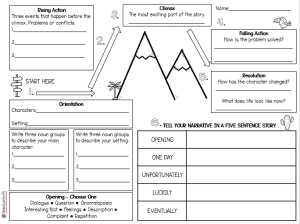
My favourite tool to help students nail their story structure is the Five Sentence Story.
What is a Five Sentence Story?
A Five Sentence Story is a handy tool that helps students to write just five sentences – one for each part of their story.
The scaffold includes:
1. Opener/Hook → 2. Orientation → 3. Complication → 4. Solution → 5. Resolution
It’s so simple that it can be used in conjunction with other planning, or on its own for a quick writing task.
What is the Five Sentence Story Template?
The template for a five sentence story varies, but the basic structure is just 5 sentences, each with a sentence starter that students complete.
Here is an example where the first line is a description of the setting:
(Prompts in BOLD and the example student answers in italics.
- One sunny day … in a beautiful seaside village.
- There lived a… fluffy dog named Pep who loved to play ball.
- Unfortunately…there were no other dogs in this village to play with, so Pep was sad!
- Luckily… Pep’s owner loved dogs and adopted a new puppy to add to their small family
- Eventually… Pep and the puppy were best of friends and Pep always had someone to play with!
Here is another example where the story begins with a complaint:
- It was the worst… hamburger ….ever!
- I had just…added the ketchup and mayo to my triple-decker cheesburger and was ready to dive in.
- Then, BOOM! Sharon, the grumpy lady from the petrol station bumped into me, squishing the sauce all over my school jumper!
- Fortunately..I had been wearing my jumper so I took it off so I didn’t have to wear a big sauce-stained uniform all day
- But I will never forget to look out for grumpy Sharon (and maybe put sauce on my burger at my table next time) again!
How do I teach Five Sentence Stories?
I use a gradual release of responsibility to teach narrative writing with this scaffold.
First, I begin by modelling the scaffold with the students. I use my Five Sentence Story Powerpoint to do this on the whiteboard.
I often choose a familiar character or student in our class to write about – students love this and it gets them really engaged. Then, I model the process, thinking aloud, so that students get my tips and tricks along the way.
Next, we move onto co-constructing Five Sentence Stories, brainstorming complications that our characters encounter, and voting on our favourite.
Want the ready-to-use version? Explore my Five Sentence Stories PowerPoint with modelling slides
Students need a bank of ideas – even creativity needs to be modelled.
When we brainstorm story elements (openings, complications, resolutions) we write them on paper or print them from the whiteboard, and put them on our Learning Wall to refer to later. We don’t leave good ideas behind – we keep them for later!
Finally, students ‘have a go’ on their own, using some of our co-constructed ideas. They need to write five great sentences that tell the entire story. I like them to practice this up to ten times.
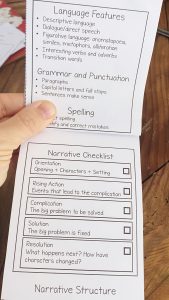
I like to use a Learning Wall with all elements on display, or a flipbook like this one, that prompts students to focus on the important elements of narrative writing.
You could incorporate Five Sentence Stories into:
- Morning Work
- Writing Stations
- English rotations
- Fast Finishers
How can you improve students’ writing with Five Sentence Stories? How to extend Five Sentence Stories to Paragraph Wrtiting:
Once students have nailed writing five sentences, they can extend the sentences to become topic sentences for paragraphs. I like to tell my students they now have to write two sentences, then three etc.
Before you (or they) know it, they have written a complete story!
Finally, all of my students edit for language features, structure, grammar, punctuation and spelling.
This is when they check they have included direct speech, descriptive language, figurative language and more, depending on their age.
I have used Five Sentence Stories (and the planning and brainstorming processes) to ‘bump up’ my students to the next level -there is nothing better that reading complete and detailed stories!
I hope that I have shared a few things you can do to help your students to write complete stories, most importantly, helping them to understand that planning is an important and productive part of the writing process, having a bank of ideas through brainstorming and planning, and then mapping out the story using a scaffold such as Five Sentence Stories.
Happy Writing!
Need a ready-to-use Five Sentence Story template?
Use my Five Sentence Stories teaching resource with editable PowerPoint slides, modelling examples and classroom activities.
I also have Five Sentence Story Fairy Tales, Five Sentence Story Opinions, Five Sentence Halloween Stories, and more!
Subscribe and get unlimited access to the Teachie Tings eLibrary for a full year!
Enjoy instant access to ALL of our resources, including daily maths slides, bump-it-up wall displays and exemplars, and our full range of learning activities.
Subscribe to Teachie Tings today!


